
TODDLER & FAMILY
How to Keep Your Toddler Screen-Free: What's Worked for Us
November 10, 2026·7 min read
Toddler & Family, Holistic Motherhood, Wild Roots Blog
By Madeleine Gray, RN · Wild Roots Blog
How do you keep a toddler busy without screens? Follow her cues, bring her into what you're already doing, keep a few toys out and rotate them, and give her time to move at her own pace. It takes patience, and it is very doable.
My daughter Evie is 20 months old, and I'm a busy mom. I work part-time but watch her most of the time, since my partner works and we're building a business, and I like to work out and cook. I'm not an expert and I definitely don't have all the answers. This is what has worked for us, and what I keep learning from reading Montessori books and watching her.
At a glance
- Follow your child's cues and help her do more of what she's drawn to.
- Bring her into your day: the kitchen, laundry, the dishwasher.
- Keep only a few toys out and rotate them every five days or so.
- Skip loud, flashing toys. Choose wooden toys and play together.
- Plan for restaurants and travel, and give yourself grace.
How do you follow your child's cues (the Montessori idea)?
I would say I've been intuitive and paid attention to Evie's cues, based on the Montessori approach, which is meeting the child where they're at. If they express interest or show a desire to do something, you help them do more of that, with guidance and safe boundaries.
For instance, she was fussing a lot in the kitchen around nine months, when she was already starting to stand and walk. Because I spend a lot of time in the kitchen, I thought, maybe she just wants to see what I do. So I bought her one of those learning towers. It had an age on it that said something like 18 months, which was way ahead of where she was. I questioned it for a minute, but I bought a used one anyway, and I'm so grateful I did, because she loved it. She needed help getting into it because she was so short, but pretty quickly she learned to climb into it herself.
Are the age recommendations on toys real limits?
It shows you how sometimes we put restrictions on kids because companies put ages on an item, and those are just recommendations, suggested averages. If your kiddo is showing interest in something, there's never a time that is too early to expose them to it, because they'll figure it out if they want to.
One note: I'm talking about developmental suggestions. Always check the safety warnings on an item, like small parts, choking hazards, and tip-over risks.
How do you keep a toddler curious while you're busy?
A lot of what kept Evie really interested and curious was following her curiosities and keeping her involved in everything I do. It just made sense to me to bring her to everything I could. It made it easier for me, and it also exposed her to new things and kept her curious, so she could explore a variety of areas.
Laundry (and the 30% success rate)
I learned early on that involving her in laundry was fun for her. She wasn't really helping, and that's what's funny about it. People say, let them do laundry, and they show cute little clips of their kid pulling out clothes. I just laugh, because that's not really realistic.
Something I've said as she's gotten older, even at this age, is that she's got about a 30% success rate. That's just my own rule of thumb, not a scientific number. From what I've read and understand of normal development, it feels pretty typical. At this age they will obviously not be perfect at completing tasks or helping with chores, but they love to participate. Doing it even a third of the time is excellent and it helps them develop the skill by continuing to do it, and for us parents to talk through it.
So we started with something simple, like having her pull out the dry clothes and put them in a “stack,” in quotes. She would focus on that activity for a long time. The stacking was a mess, of course, but she was very proud of herself, and I was happy for her engagement. I loved watching her excitement in helping me.
As she's gotten older, it's gotten slightly more challenging. In the beginning it was small tasks like that, or starting to help empty the dishwasher one thing at a time.
Pro tip: Start with one tiny job she can finish, like pulling dry clothes out of the dryer. A small win keeps her focused and gives her somewhere to put her energy.
What's the hardest part? Patience.
Really, it's just remembering patience, because they move at a snail's pace. And if they aren't moving at a snail's pace, they're dropping and breaking stuff. So letting them do it at their pace has been super helpful for me to keep in mind. It keeps her focused and gives her somewhere to place her energy. Things definitely take forever to get done, but that's part of having kids.
One of my favorite reminders through this whole mothering process has been to slow down, because that has been relatively difficult for me my entire life. I really didn't even learn to relax until I was 30, LOL. I literally didn't know what it meant to take a break and just sit in silence until about that age. So having a kid has been great for slowing down and meeting her at her pace.
How do you handle restaurants screen-free?
We haven't gone to a lot of restaurants since she was born. I know other people eat out a lot, so this may be more challenging for them. But being screen-free means a lot of attention on the child. It's very difficult for kids under two to sit still at a table while we eat and converse. They want to run around.
That's when I'm so grateful we live in Austin, where all restaurants have a huge outdoor area and a significant portion of them are child friendly with play areas, so we can choose those restaurants and make it easier for everyone.
On the few occasions we've gone to nicer restaurants with guests or friends who come into town, we alternate. I sit and eat for a few minutes, and when Evie's done eating and wants to run around, I chase her for a few minutes. Then we switch: when Ryan's done eating, he can chase her and let her explore safely.
How do you handle travel without screens?
We've taken several trips with her, and that's another difficult area to keep kids screen-free, when there are screens galore. One behind every seat, everyone on their phone. That's why I bring unique tactile things, like puffy balls and things that can stick to the back of the seat or the windows. A few books, and definitely a ton of snacks.
This is where I loosen up a bit, because I am not perfect, and on occasion a screen is permitted, because we do live in modern times. My only rule is that I don't use it as an escape. On a long flight, we've pulled out a couple of slow shows intermittently, in between our interactive play. Our two favorite shows are Sesame Street and Puffin Rock. Besides that, we'll let her watch live symphony on YouTube.
What activities work once they're running?
Once Evie got to the running stage, where she doesn't want to sit down and needs a lot of stimulation and activity, giving her activities actually got a little more difficult. So I started including things where we collect items, like pushing a cart around the house or taking it outside. She still loves that a lot. We push her shopping cart around the neighborhood, and she can put rocks and sticks in it.
Rotate toys every five days
I still offer limited activities over about five days at a time, so she's not overstimulated. A few games, like blocks or putting toys into slots, are left out, and everything else is put away. Then we rotate so everything is new every five days or so. It also reduces clutter and keeps the mess down.
Why do you skip high-stim toys?
I'm constantly researching new ideas and reading different Montessori books to keep learning fun and keep her engaged and focused, but also to keep her nervous system regulated.
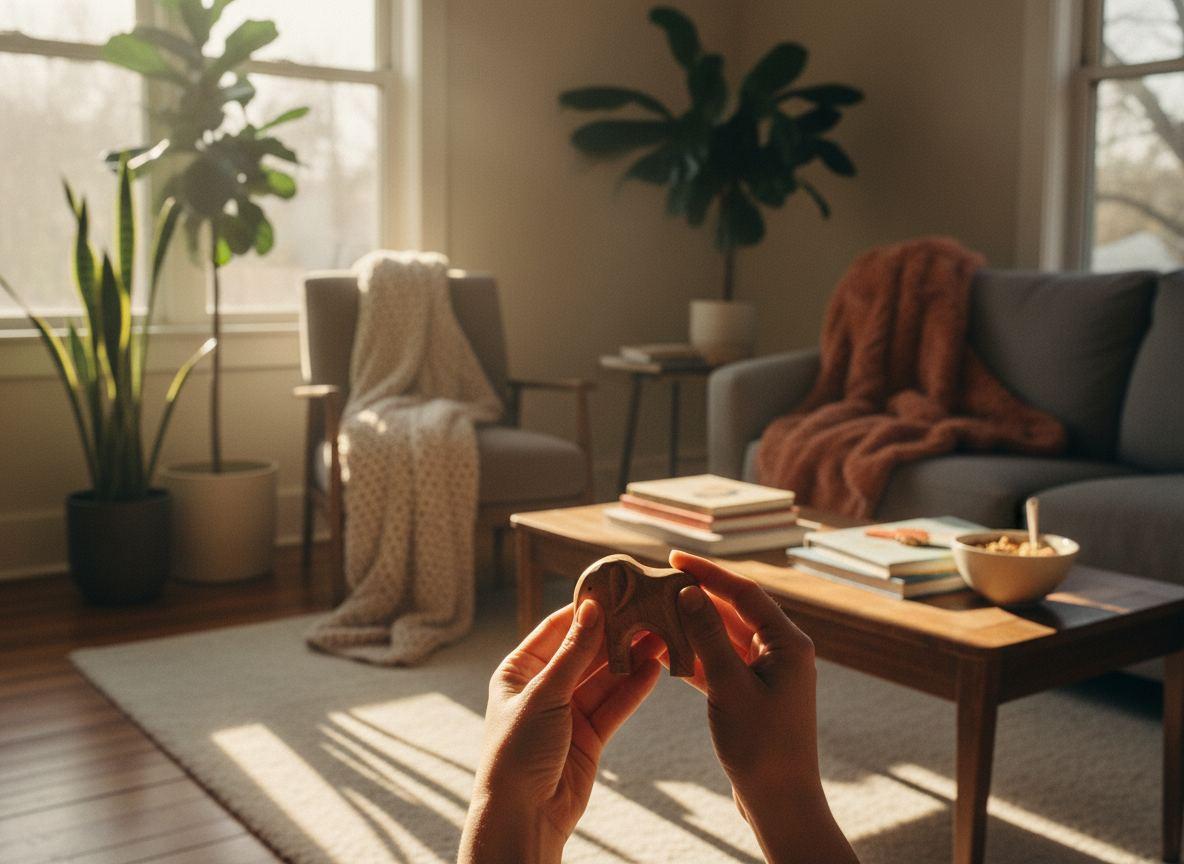
A lot of the toys made for kids these days are very high-stim: loud, flashing, shining. We skipped all of those because they were too much. Those were created in our capitalist culture because children make a ton of money for companies selling to them, so I don't think any of them are necessary. We prefer wooden toys, or things we do together: interactive play.
What about screens?
The American Academy of Pediatrics recommends avoiding screens for children under 18 months, other than video chatting with family. That is why we keep it to one short, slow-moving show, and only when we need it. Evie is 20 months now, and I still keep it limited and never use it as an escape.
Key takeaway: Screen-free isn't about being perfect. It's about paying attention to your child, including her in your day, and letting her move at her own pace.
Frequently asked questions
What do I do when my toddler wants to "help" and it takes forever?
Let her do it at her pace. Things take longer, but it keeps her focused and gives her somewhere to place her energy.
How many toys should I keep out?
A few. We leave out a couple of games, like blocks or putting toys into slots, put everything else away, and rotate about every five days.
Are screens ever okay?
The AAP recommends avoiding screens under 18 months, other than video chatting. For us, after that, a screen is a short, slow show when we need it. My only rule is I don't use it as an escape.
How do you handle a restaurant with a toddler?
We pick child-friendly places with outdoor space or play areas, and when we go somewhere nicer, my partner and I take turns eating and chasing her.
What do you bring on a trip?
Tactile things like puffy balls and items that stick to the seat or window, a few books, and a ton of snacks.
If you're a mama in Austin looking for a community to do this with, I teach baby-wearing and Mommy & Me movement classes. See the class schedule. And if the idea of presence over perfection speaks to you, you might like Intentional Parenting Over Perfection.
This post is education and my own experience, not medical or developmental advice. Talk with your pediatrician about your child's needs.
Looking for community and movement with your little one?
KEEP READING


Want to go deeper?
If something here landed, we can talk it through — slowly, and on your terms.
Book a Free ConsultOr get nutrition, movement, and labs together in one day each week: The Weekly Visit.