
TODDLER & FAMILY
18 Months In: The Honest Truth About Breastfeeding a Toddler
October 29, 2026·7 min read
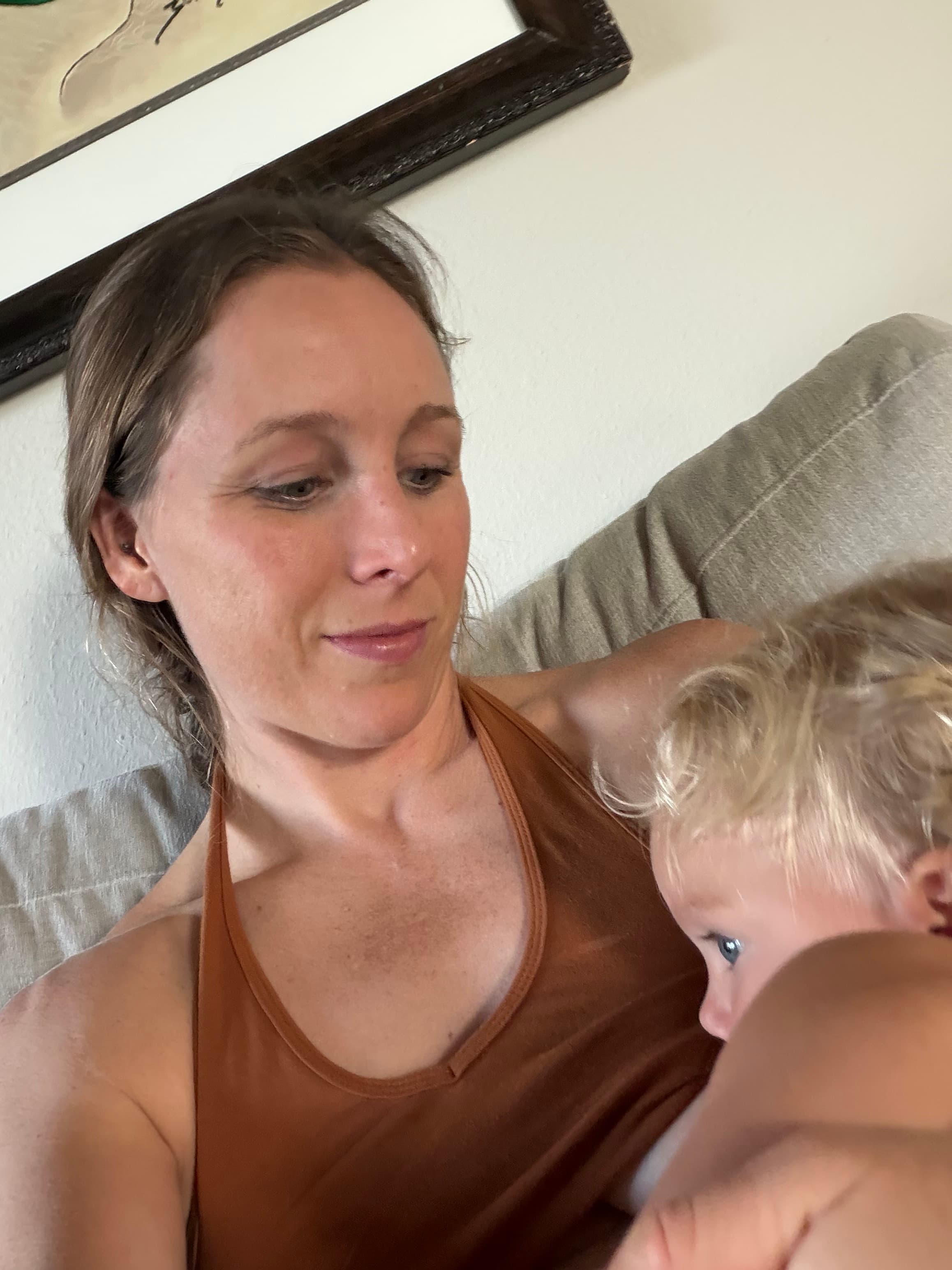
Holistic Motherhood, Toddler & Family, Wild Roots Blog
By Madeleine Gray, RN · Wild Roots Blog · Published October 29, 2026
Breastfeeding a toddler is harder than breastfeeding a newborn, and the World Health Organization recommends nursing for at least two years alongside food. Here is why that does not get talked about honestly, and what is actually behind it.
Breastfeeding at 18 months is freaking wild.
I want to give my honest feedback here, because I know a lot of people do not breastfeed this long, and I do not think anyone tells the truth about what it is actually like.
So here it is: it is harder now than it was when she was a newborn.
Why it is harder, which is not what I expected
When Evie was a newborn, it was exhausting. You sit all day and you feed nonstop and there is very little else. But to some degree that is expected. Everyone tells you the newborn phase will swallow you whole. So I felt like it was much easier to accept, because I had been warned, and because there was nothing else I was supposed to be doing.
Now at 18 months she asks to nurse at all sorts of times, and I am like, oh my God, really? Right now?
It feels like more of an interruption.
I will make a sidenote here and say I have heard many other women describe feeling that way from the very beginning. So I am not claiming this is unique to toddler nursing. I am just telling you where I am, honestly, because I think the honest version is more useful than the pretty one.
And I keep going anyway.
Why I keep going
My point of view is that breastfeeding is best for as long as possible. It is so good for so many things.
The World Health Organization recommends breastfeeding for at least two years, alongside food from around six months. That is not a niche opinion. That is the global standard.
We are just one of the only countries that really normalizes quitting early, or supplementing with formula as the default first answer. Many other cultures breastfeed well past two years. Some to four or five. People here in America would think that is absolutely insane.
It is not insane. It is normal almost everywhere else.
A few things I wish more women knew:
Breast milk does not turn to water after a year. It keeps delivering antibodies, and it keeps adapting to what your child actually needs. In one study, secretory IgA, the main antibody in milk, was highest after the second year of lactation (source 1).
For a toddler, nursing is not only nutrition. It is nervous system regulation. It is co-regulation. It is the fastest way I have to bring my daughter back down when she is sick, overwhelmed, or in the middle of a transition she does not have words for yet. Ryan goes deep on the actual mechanism behind this over on The Holistic Hub — Breathwork: The Fastest Switch for Your Nervous System — if you want the science of why this works, not just that it does.
It is not only for the baby. Each 12 months of breastfeeding is linked to about a 4% lower risk of breast cancer for the mother (source 2). Longer breastfeeding is also linked to lower rates of ovarian cancer and type 2 diabetes (source 3).
Where I actually want to put my energy
I want to be careful here, because this is the part people get wrong about me.
This is not a judgment on women who could not breastfeed. Maybe I cannot fully say I do not judge someone who chooses not to, when it really is a choice. But the longer I do this work, the more I understand that is not always a free choice. It is one that has been ingrained in people, through propaganda, through cultural norms nobody ever actually chose for themselves.
Here is what I actually see: there is an enormous gap in information for women around breastfeeding, starting the moment they give birth.
Most women are not choosing between two well-supported options. They are exhausted, they are getting conflicting advice, nobody has told them what normal looks like, and the answer that appears at 3am is a product rather than a person.
That is not a choice. That is being routed.
And I do not have to guess about this, because the women tell me themselves.
I hear it all the time from women whose children are grown now. If only I had known more back then, I would have done it differently.
Sit with that for a second. That is not a woman who weighed her options and picked one. That is a woman who found out years later that there had been another option, and nobody told her while it still mattered.
I have heard some version of that sentence more times than I can count. It is the same sentence every time.
So when I meet a woman who stopped, I am not thinking she should have tried harder. I am thinking, who was supposed to help her, and where were they?
That is where I want to focus my energy. As a nurse, as a holistic health practitioner, and as someone who works with women, education is the whole thing for me. Especially here.
Because I feel passionate about supporting the next generation and helping them build a better world. And that starts with nourishing our babies as well as we possibly can, and with making sure their mothers actually have what they need to do it. It is the same reason I started this blog in the first place.
If you are still going
Good on you. It is a commitment and it does not get talked about honestly enough.
And if today it felt like an interruption, if you thought oh my God, right now?, you are not doing it wrong. That thought and the commitment can live in the same body at the same time. Mine do, most days.
She still asks. I still answer. That is the whole thing.
- Madeleine
Holistic RN · Mama · @the_holistic_momma
FAQ
How long does the World Health Organization recommend breastfeeding? At least two years, alongside solid food starting around six months. This is the global standard, not a niche opinion.
Does breast milk lose nutritional value after one year? No. Breast milk keeps delivering antibodies and keeps adapting to what your child actually needs well past the first year.
Is it normal for toddler nursing to feel harder than newborn nursing? Yes. The newborn phase is exhausting but expected; toddler nursing arrives as interruptions in a life you are already living, which can feel harder even though it is developmentally normal.
What are the benefits of breastfeeding a toddler? Continued antibodies and adapted nutrition, plus nervous system co-regulation, nursing is often the fastest way to help a toddler settle when they are overwhelmed or in transition.
Are there benefits for the mother? Each 12 months of breastfeeding is linked to about a 4% lower risk of breast cancer. Longer breastfeeding is also linked to lower rates of ovarian cancer and type 2 diabetes.
Sources
- Czosnykowska-Lukacka M, et al. Changes in human milk immunoglobulin profile during prolonged lactation. Frontiers in Pediatrics, 2020.
- Collaborative Group on Hormonal Factors in Breast Cancer. Breast cancer and breastfeeding: collaborative reanalysis of individual data from 47 epidemiological studies. The Lancet, 2002. PMID 12133652.
- Chowdhury R, et al. Breastfeeding and maternal health outcomes: a systematic review and meta-analysis. Acta Paediatrica, 2015. PMID 26172878.
- World Health Organization. Breastfeeding recommendations: at least two years, alongside food from about six months.
This post is educational and not medical advice. Talk with your own provider about your health.
Looking for community and movement with your little one?
KEEP READING

Want to go deeper?
If something here landed, we can talk it through — slowly, and on your terms.
Book a Free ConsultOr get nutrition, movement, and labs together in one day each week: The Weekly Visit.